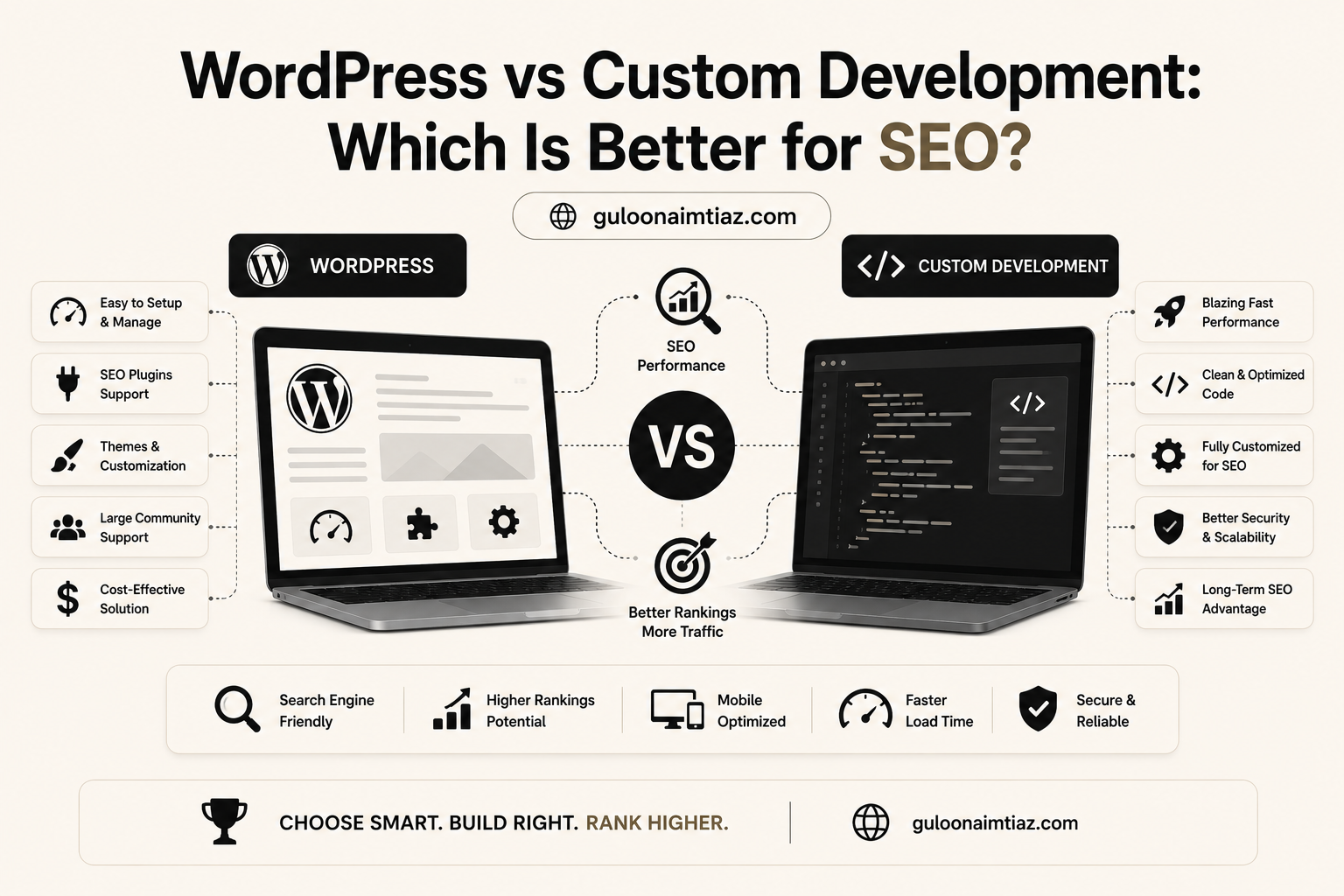
When businesses plan a new website, one of the biggest questions they ask is: should they use WordPress or build a completely custom website? The debate becomes even more important when SEO is involved because search engine visibility directly impacts traffic, leads, and revenue.
Some developers argue that custom-built websites perform better because they offer cleaner code, faster loading times, and complete flexibility. Others believe WordPress is the better option because of its SEO-friendly ecosystem, content management capabilities, and powerful plugins.
The truth is more nuanced. Google does not rank websites simply because they are built on WordPress or custom code. Search engines care about user experience, content quality, page speed, mobile responsiveness, crawlability, and technical optimization. A poorly built custom website can perform worse than a well-optimized WordPress site, while a bloated WordPress installation can struggle against a lightweight custom solution.
This guide explains the SEO strengths and weaknesses of both WordPress and custom development, helping businesses decide which solution fits their goals best.
What Is WordPress Development?
WordPress is an open-source content management system (CMS) that powers over 40% of websites globally. It allows businesses to build websites using themes, plugins, and page builders without developing everything from scratch.
WordPress is widely used for:
- Business websites
- Blogs and magazines
- E-commerce stores
- Service-based companies
- Portfolio websites
- Educational platforms
One of WordPress’s biggest advantages is its plugin ecosystem. SEO tools like Yoast SEO and Rank Math simplify technical SEO tasks such as:
- XML sitemaps
- Meta titles and descriptions
- Schema markup
- Canonical tags
- Open Graph settings
- Breadcrumbs
This makes WordPress highly accessible even for non-technical users.
What Is Custom Development?
Custom development means building a website from scratch using programming languages and frameworks such as:
- PHP
- Laravel
- React
- Next.js
- Node.js
- Vue.js
Unlike WordPress, custom websites are tailored specifically for business requirements. Developers have full control over:
- Website architecture
- Database structure
- Front-end performance
- Server-side rendering
- Technical SEO implementation
- API integrations
- Security layers
Custom websites are often used for:
- SaaS platforms
- Enterprise portals
- Large marketplaces
- Complex applications
- Custom dashboards
- High-performance web apps
Because everything is developed specifically for the project, custom websites can achieve extremely high performance and flexibility. However, they also require significantly more time, budget, and technical expertise.
How Google Actually Evaluates SEO
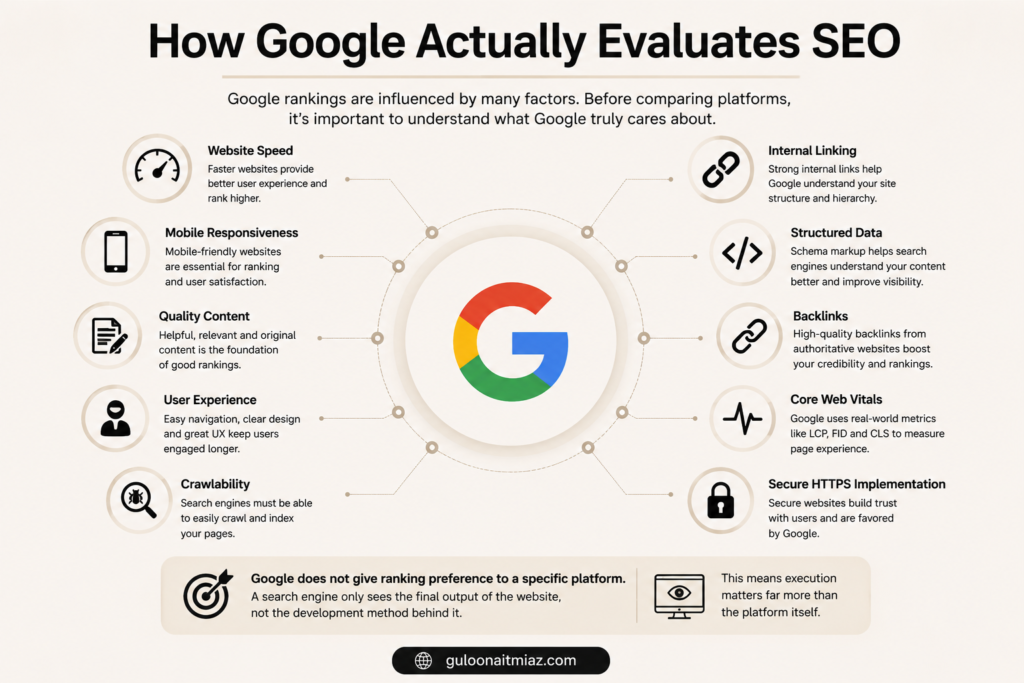
Before comparing WordPress and custom development, it is important to understand what Google truly cares about.
Google rankings are influenced by factors such as:
- Website speed
- Mobile responsiveness
- Quality content
- User experience
- Crawlability
- Internal linking
- Structured data
- Backlinks
- Core Web Vitals
- Secure HTTPS implementation
Google does not give ranking preference to a specific platform. A search engine only sees the final output of the website, not the development method behind it.
This means execution matters far more than the platform itself.
WordPress SEO Advantages
1. SEO Plugins Simplify Optimization
One of the strongest SEO benefits of WordPress is its plugin ecosystem.
Plugins like Yoast SEO and Rank Math allow users to optimize pages without technical knowledge. Businesses can easily manage:
- Meta titles
- Meta descriptions
- Canonical URLs
- XML sitemaps
- Schema markup
- Social previews
Instead of manually coding these features, WordPress provides them through simple interfaces.
This significantly reduces development time and makes ongoing SEO management easier.
2. Easy Content Publishing
SEO success depends heavily on consistent content creation.
WordPress was originally designed as a publishing platform, which makes it excellent for:
- Blogging
- Landing pages
- Content marketing
- Category management
- Internal linking
- Media management
Marketing teams can publish and update content without needing developers. This is a huge advantage because businesses that regularly update content often perform better in search rankings.
Many Reddit discussions also highlight that content consistency matters more than the platform itself.
3. Faster Time to Market
WordPress websites can be launched quickly compared to custom projects.
Businesses can:
- Use pre-built themes
- Install SEO plugins
- Configure caching tools
- Launch within days or weeks
A faster launch means SEO campaigns can begin earlier, which helps websites gain authority sooner.
Custom projects often require months of development before SEO work even begins.
4. Large SEO Ecosystem
WordPress has a massive community of developers, marketers, and SEO professionals.
This ecosystem provides:
- Tutorials
- Documentation
- SEO tools
- Plugins
- Technical support
- Security updates
Finding WordPress SEO specialists is generally easier and more affordable compared to hiring custom framework experts.
5. Excellent for Content-Driven Websites
For websites heavily focused on content marketing, WordPress often performs exceptionally well.
Examples include:
- News websites
- Blogs
- Educational platforms
- Service company websites
- Affiliate websites
Its structure naturally supports categories, tags, archives, and blogging systems.
WordPress SEO Disadvantages
1. Plugin Bloat
The biggest SEO issue with WordPress is excessive plugin usage.
Many websites install dozens of plugins, leading to:
- Slow loading speeds
- Extra CSS and JavaScript
- Database overhead
- Render-blocking assets
Heavy themes and page builders can also negatively impact Core Web Vitals.
However, these problems are usually caused by poor implementation rather than WordPress itself.
2. Security Risks
Because WordPress is extremely popular, it is a common target for attacks.
Outdated plugins and themes can introduce vulnerabilities that affect:
- Site performance
- SEO rankings
- User trust
If a website gets hacked, Google may blacklist it or display security warnings in search results.
3. Dependency on Third-Party Tools
Many WordPress websites rely heavily on plugins for functionality.
This can create problems when:
- Plugins become abandoned
- Updates break compatibility
- Features conflict with each other
Over time, plugin dependency may increase maintenance complexity.
Custom Development SEO Advantages
1. Cleaner and Faster Code
Custom websites are typically leaner because developers build only what is necessary.
This often results in:
- Faster loading times
- Better Core Web Vitals
- Reduced code bloat
- Improved crawl efficiency
Custom-built websites can achieve exceptional performance scores when developed properly.
For SEO, speed matters because Google uses page experience signals as ranking factors.
2. Full Technical SEO Control
Custom development allows developers to control every technical aspect of SEO.
This includes:
- URL structures
- Rendering methods
- Structured data
- Server configuration
- Database optimization
- Dynamic content rendering
This level of control is especially valuable for large or technically complex websites.
3. Better Scalability
Large websites with complex functionality often benefit from custom architecture.
Examples include:
- Enterprise platforms
- SaaS applications
- Marketplaces
- Large e-commerce stores
- Membership platforms
Custom systems can scale more efficiently because they are designed specifically for the project’s needs.
4. Improved Security Structure
Custom websites have smaller attack surfaces compared to WordPress.
Automated attacks targeting common WordPress vulnerabilities generally do not apply to custom systems.
This can indirectly support SEO by reducing downtime and security risks.
5. Advanced Performance Optimization
Frameworks like Next.js and server-side rendering technologies can dramatically improve website speed and rendering efficiency.
This is particularly useful for:
- JavaScript-heavy applications
- Dynamic websites
- High-traffic platforms
Modern custom frameworks can achieve outstanding Core Web Vitals performance.
Custom Development SEO Disadvantages
1. Higher Development Costs
Custom websites require:
- Experienced developers
- Longer development cycles
- Technical SEO planning
- Ongoing maintenance
This significantly increases costs compared to WordPress.
2. Longer Launch Timelines
A custom website may take months to complete.
This delays:
- Content publishing
- SEO campaigns
- Indexing
- Organic traffic growth
Businesses seeking rapid deployment may find this problematic.
3. Content Management Can Be Harder
Many custom websites lack intuitive content management systems.
Without a proper CMS interface:
- Content updates require developers
- SEO changes become slower
- Marketing teams lose flexibility
This can reduce content publishing frequency, which negatively impacts long-term SEO growth.
4. SEO Features Must Be Built Manually
Unlike WordPress, custom systems do not automatically include SEO tools.
Developers must manually implement:
- Sitemaps
- Schema
- Canonicals
- Redirects
- Meta tags
If SEO is not considered early in development, technical issues can arise later.
Core Web Vitals Comparison
Google’s Core Web Vitals focus on:
- Loading speed
- Interactivity
- Visual stability
Custom websites generally have an advantage because they use cleaner code and fewer dependencies.
However, optimized WordPress websites can still achieve excellent performance with:
- Lightweight themes
- Proper caching
- CDN usage
- Image optimization
- Minimal plugins
A well-optimized WordPress site can outperform a poorly developed custom website.
Which Option Is Better for Small Businesses?
For most small and medium businesses, WordPress is usually the better choice.
Why?
Because SEO success depends heavily on:
- Regular content publishing
- Easy page management
- Budget-friendly optimization
- Faster implementation
WordPress allows businesses to focus on SEO strategy rather than technical infrastructure.
For service businesses, agencies, blogs, and local businesses, WordPress often delivers the best balance of:
- Cost
- SEO functionality
- Ease of management
- Scalability
Which Option Is Better for Enterprise SEO?
Custom development becomes more valuable when businesses require:
- Complex web applications
- Custom workflows
- Advanced APIs
- Massive scalability
- Specialized technical SEO
Large organizations may benefit from custom frameworks because they need performance optimization beyond typical CMS limitations.
In these cases, development teams can engineer SEO directly into the architecture.
Hybrid Approach: Headless WordPress
An increasingly popular solution is headless WordPress.
This combines:
- WordPress as the content management backend
- Custom front-end frameworks like React or Next.js
Benefits include:
- Easy content management
- Faster front-end performance
- Better scalability
- Advanced SEO control
Many modern businesses choose this hybrid approach because it offers the strengths of both systems.
Common SEO Mistakes in Both Approaches
Whether using WordPress or custom development, businesses often make the same SEO mistakes:
- Ignoring site speed
- Poor heading structure
- Weak internal linking
- Thin content
- Duplicate pages
- Bad mobile experience
- Missing schema markup
- Poor crawl management
These issues affect rankings far more than the platform choice itself.
Final Verdict: Which Is Better for SEO?
The answer depends on the project requirements.
Choose WordPress if you need:
- Faster launch times
- Easier content management
- Lower costs
- Strong SEO plugins
- Content-focused marketing
Choose custom development if you need:
- Maximum performance
- Advanced scalability
- Unique functionality
- Full technical control
- Complex integrations
For most businesses, WordPress is more than capable of achieving excellent SEO results when properly optimized. Custom development only becomes necessary when technical requirements exceed what a CMS can realistically handle.
In the end, SEO success is not determined by whether a website is built with WordPress or custom code. Rankings depend on strategy, implementation quality, content value, user experience, and ongoing optimization. A fast, user-friendly, well-structured website with great content will always outperform a poorly optimized competitor—regardless of the platform behind it.